
You notice it after you sit down. The chair's backrest curves in one smooth line, meeting your back before you've thought about adjusting your posture at all.
In Hida, a forested, mountainous region of Gifu Prefecture in central Japan, furniture makers have developed ways of shaping wood around the way people sit and live. One technique closely associated with the region is steam bending, used to create the flowing curves seen in some chair backs and arms.
But bentwood is only part of the story. Hida furniture draws on a broader culture of woodworking that includes carving, joinery, sanding, finishing and upholstery. The region is especially known for dining chairs, though its makers also produce dining tables, sofas, sideboards and personal armchairs. These techniques are adapted to different materials, designs and everyday uses.
Hida's identity as a woodworking region reaches back more than a thousand years. During Japan's Nara period (710–794), skilled woodworkers from Hida were sent to work for the central government in place of part of the region's tax obligations. These craftsmen became known as “Hida no Takumi”, the master artisans of Hida, and worked on palaces, temples and other major building projects.
This early history doesn't mean that today's furniture-making techniques have been passed down unchanged since the Nara period. Rather, it forms an important part of Hida's long-standing identity as a region associated with skilled woodworking.
The modern furniture industry began much later, in 1920. A group of local investors founded Chuo Mokko, the company now known as Hida Sangyo, with the aim of finding a practical use for the beech growing abundantly in the surrounding mountains. At the time, beech was considered difficult to use for furniture because of its tendency to warp.
The introduction of Western steam-bending techniques offered another possibility, allowing makers to turn the region's abundant beech into curved components for furniture production. This helped turn a difficult local material into a useful resource for furniture production and became an important step in the development of Hida as a modern furniture-making region.
After World War II, Japanese homes increasingly adopted Western-style dining tables and chairs alongside more traditional floor-based ways of living. Demand for dining furniture grew, and manufacturers developed in the region, strengthening Hida's furniture-making cluster.
The industry continued to experiment with materials and manufacturing methods. Some makers developed techniques for compressing cedar, a relatively soft wood, to make it suitable for certain furniture applications. Others began incorporating visible knots into selected designs rather than automatically treating them as defects to be removed.
Hida furniture, then, is not simply the continuation of an ancient craft. It is a modern regional furniture industry shaped by a much older woodworking culture, and by more than a century of adaptation in materials, technology and design.
Two techniques are particularly useful for understanding how many Hida chairs are shaped and experienced: steam bending and contoured seat carving.
Bentwood: Shaping a Curve Without Cutting Through the Grain
For bentwood components, solid wood is heated and humidified until it becomes flexible, then bent around a form and dried in that shape.
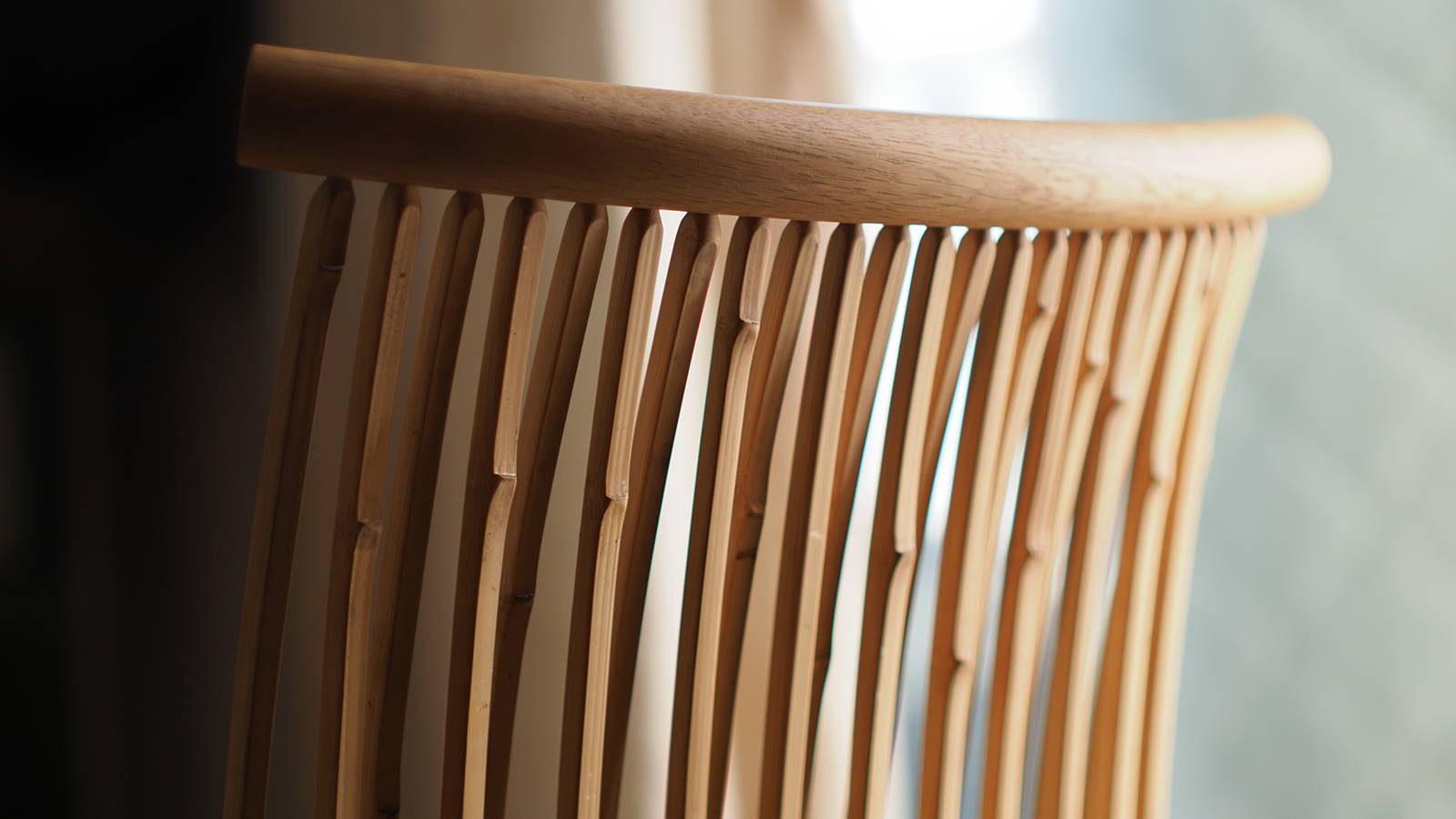
Unlike creating a curve primarily by carving material away, steam bending allows much of the wood's grain to continue through the curve. This can help a curved component retain strength while reducing the number of separate pieces needed to create the form.
On chairs, the technique is often used for backrests and arms. Visually, it can appear as a long sweep of wood with few interruptions; to the hand, careful sanding can make the transition across the curve feel almost continuous.
Contoured Seat Carving: Zaguri
Another technique found on some solid-wood chairs is a shallow, contoured seat carving known in Japanese as zaguri.
Instead of leaving the wooden seat completely flat, the maker removes material to create a gentle hollow where the body meets the chair. The result changes how the body's weight meets the surface compared with a flat wooden seat.
The effect is subtle to look at. It becomes clearer when you sit down: the seat isn't simply a flat board beneath you, but a surface whose shape has been considered in relation to the body.
As with bentwood, zaguri isn't a feature of every Hida chair. Upholstered chairs and other seat constructions use different approaches, and the precise shape varies from one design to another.
Together, these techniques illustrate a broader characteristic of Hida furniture: the visible form of a chair often comes from decisions about material, construction and the way the finished object will be used. The curve of a backrest or hollow of a wooden seat isn't simply decorative. It is part of how wood is shaped into something that will be touched, sat on and lived with every day.
1. Selecting and Drying the Wood
The process begins with selecting wood suited to the intended component and design. Hida furniture makers work with species including beech, oak, walnut, chestnut, birch and cedar, among others. The choice depends on factors such as grain, hardness, stability, appearance and the way the material will be shaped.
Before machining and assembly, the wood is dried to bring its moisture content to a level appropriate for furniture production. Controlled drying helps reduce dimensional changes after the furniture enters a home.
2. Cutting and Machining the Components
The dried timber is cut into the components required for the piece. Modern machinery can provide consistent dimensions and repeatable cuts, particularly where multiple components need to fit together accurately. This stage establishes the basic geometry that later processes refine.
3. Steam Bending — When the Design Requires It
Components that require bentwood are steam-bent around a form and held in position while they cool and dry. This step is used only when required by the design, particularly for certain chair backs and arms.
4. Carving and Shaping
Components are machined and shaped according to the design. On some solid-wood chairs, this includes creating a shallow contoured seat, a technique known in Japanese as zaguri. Other components may be carved or refined to create tapered legs, curved edges, or surfaces designed to meet the hand or body.
5. Joinery and Assembly
The prepared components are assembled into the finished structure. Depending on the furniture, this may include mortise-and-tenon joinery, in which a projecting section of one component fits into a corresponding recess in another. Makers may combine traditional joint structures with adhesives, hardware, or other contemporary construction methods according to the product.
6. Sanding by Hand
After machining and assembly, surfaces are progressively sanded and refined. Machinery can handle parts of this process, but hand finishing remains useful where curved surfaces, joints and edges need to be checked by touch. Running a hand over a chair back or arm can reveal small irregularities that are less obvious to the eye.
This stage also affects how the finished furniture feels in daily use. A curve that appears smooth from across the room is experienced differently when a hand moves directly across it.
7. Applying the Finish
The final surface treatment depends on the product and manufacturer. Oil finishes penetrate the wood and generally leave the grain and tactile character relatively direct. Polyurethane finishes create a protective film over the surface and tend to offer greater resistance to moisture and everyday staining.
Other finishes may also be used. Care requirements therefore depend on the actual product rather than simply on whether it is described as Hida furniture.
The character of wooden furniture is not experienced only when it is new. It becomes apparent in small, repeated moments: sitting down at breakfast, running a hand along the back of a chair, wiping a table after dinner, or noticing how the surface has changed after years of use.