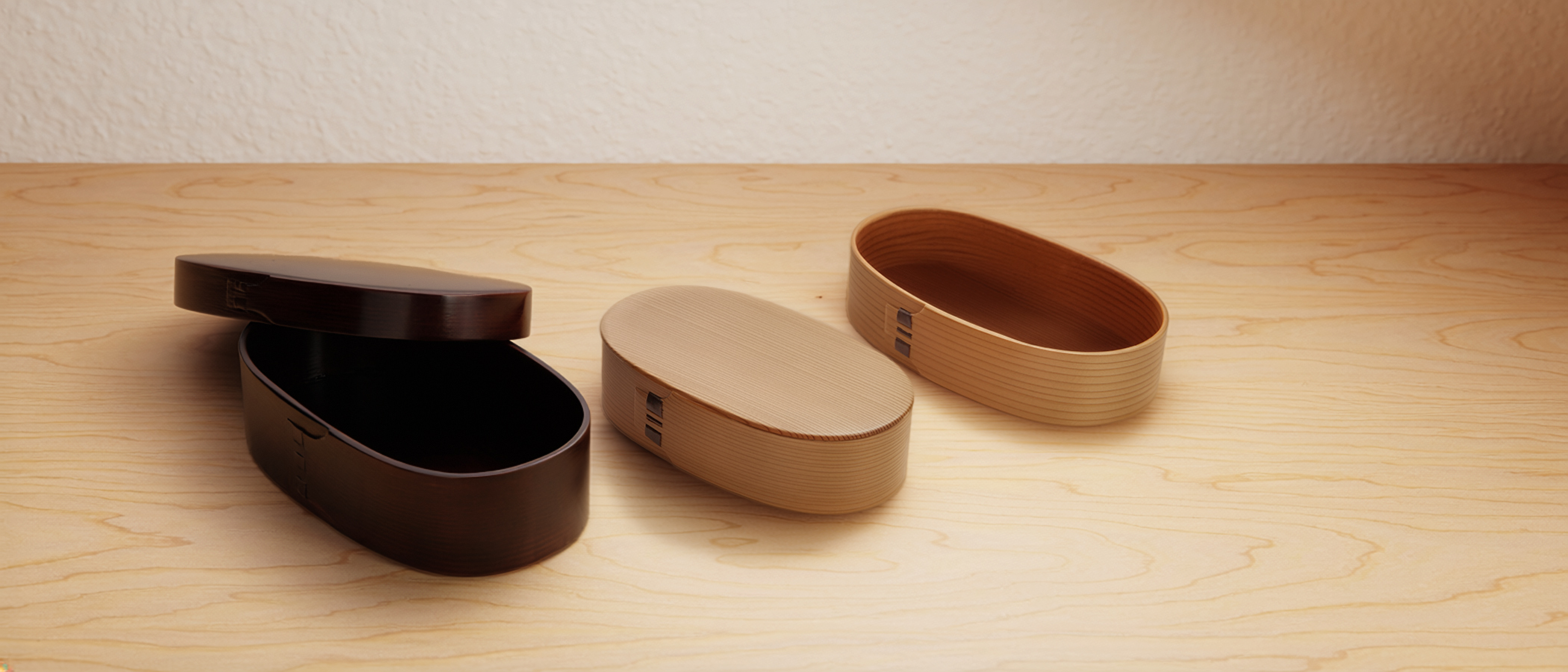
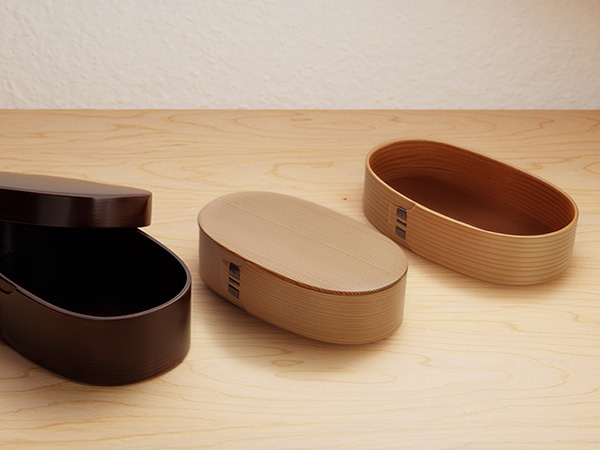
Pick up an Odate Magewappa bento box and one detail is difficult to miss: the wood grain runs in long, straight lines across its surface.
Magewappa is a general Japanese term for containers made by bending thin sheets of wood into rounded forms. Similar bentwood traditions developed in several regions of Japan. Odate Magewappa refers specifically to the tradition associated with Odate in Akita Prefecture in northern Japan.
Odate Magewappa is made from Akita cedar cut in a quarter-sawn orientation. This produces the straight, parallel grain that is one of the craft's most recognizable visual characteristics. The wood is split and shaved into thin boards, softened with heat, bent into shape, and joined using strips of mountain cherry bark.
Historically, Odate Magewappa was closely associated with the region's cedar forests. Natural Akita cedar was long regarded as an important material for the craft. However, logging of natural Akita cedar in national forests ended in 2013, and contemporary production also uses plantation-grown Akita cedar and other appropriately selected cedar resources.
The finished object may be left unfinished, coated with urethane, or finished with lacquer. That choice changes more than appearance.
Unfinished wood remains relatively exposed and can interact more directly with moisture, but it also requires careful washing and thorough drying. Urethane creates a protective coating that generally makes everyday maintenance easier. Lacquer provides another protective finish while giving the surface its own color and texture.
Bentwood containers have a long history in Japan. Archaeological evidence suggests that techniques for bending thin pieces of wood into vessels were already present in ancient times.
In the Odate area, the development of Magewappa as a regional industry became more clearly established during the 17th century.
The Satake-Nishi family, who governed the Odate area as part of Japan's feudal domain system, encouraged local samurai to make bentwood products as supplementary work. The region's abundant cedar resources provided suitable material, and production gradually developed into a local industry.
Magewappa products were used for practical containers including lunch boxes, rice containers, and other vessels for food and daily life.
Demand declined in the mid-20th century as plastic and metal containers became widely available. Compared with inexpensive industrial materials, bentwood containers required more specialized production and care.
The craft nevertheless continued. In 1980, Odate Magewappa was officially designated by the Japanese government as a Traditional Craft, recognizing its established regional production history, materials, and techniques.
Today, bento boxes are among the best-known Odate Magewappa products, but the tradition also includes rice containers, tiered boxes, trays, confectionery containers, sake vessels, and other objects.
The material situation has changed as well. Natural Akita cedar once played a particularly prominent role, but the end of logging in national forests in 2013 means that contemporary makers work within a different forestry environment. Understanding today's Odate Magewappa therefore also means recognizing that a centuries-old craft does not necessarily rely on exactly the same material supply forever.
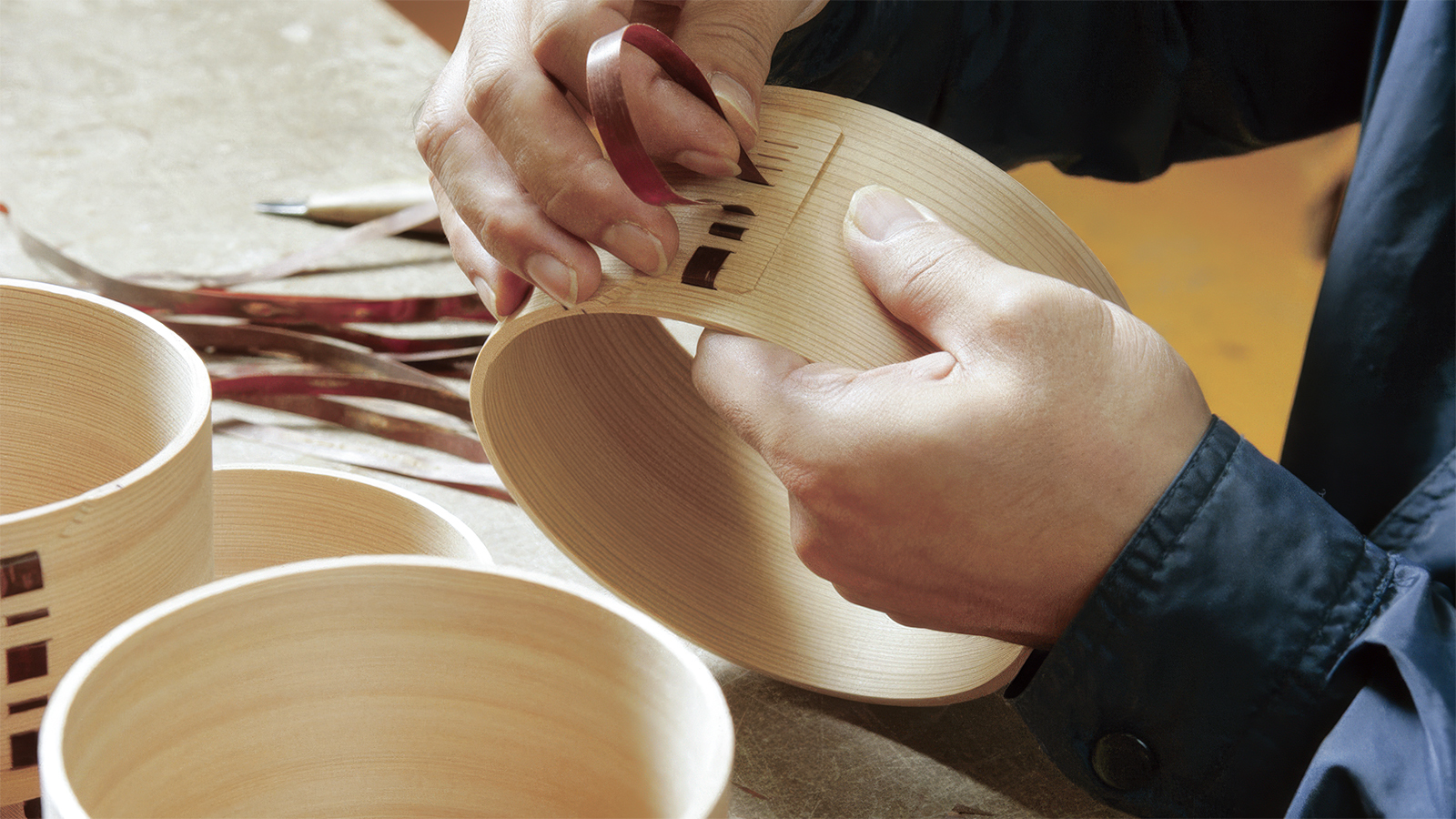
Odate Magewappa is recognizable through a combination of straight cedar grain, bentwood construction, cherry-bark stitching, and the natural character of its wooden surface.
The straight lines visible across many Odate Magewappa objects result from how the cedar is cut. A quarter-sawn orientation exposes the wood grain in relatively straight, parallel lines. The resulting boards are then split and shaved thin enough to be bent without losing the visual continuity of the grain.
A Magewappa box is not typically carved from a solid block of wood. Instead, a thin cedar board is softened with heat and bent into a rounded wall. The overlapping ends are joined, traditionally with narrow strips of mountain cherry bark.
Because the container is formed from thin bentwood rather than carved from a solid block, it can remain relatively light even when large enough to hold a meal or cooked rice.
When left unfinished, the cedar surface remains relatively exposed. In this form, the wood can absorb some excess moisture from warm rice and later release moisture as conditions change. This can help reduce condensation inside the container and help rice retain its texture after packing.
Odate Magewappa depends on turning a straight piece of cedar into a stable curved form.
1. Selecting and Cutting the Cedar
Cedar is selected for grain, condition, and suitability for bending. The wood is cut in a quarter-sawn orientation so that the grain appears relatively straight on the finished surface.
2. Splitting and Shaving the Boards
The cedar is split and shaved into thin boards. Thickness matters. The wood needs enough substance to hold its form once finished, but it must also be thin and even enough to bend without cracking.
3. Softening the Wood With Heat
The prepared board is heated, traditionally using hot water or steam, to make the wood more flexible. Heat softens the material sufficiently for it to be bent around a form.
4. Bending and Drying
While the board is flexible, it is bent into the intended shape. The curved wood is then held in position and allowed to dry. As moisture leaves the wood, the piece stabilizes in its new form.
5. Joining With Cherry Bark
The overlapping ends are secured using narrow strips of mountain cherry bark. The stitching is both structural and visible. Rather than concealing the joint completely, the construction becomes one of the recognizable details of Odate Magewappa.
6. Adding the Base and Finishing
A base is fitted to complete the container. Depending on the product, the surface may remain unfinished or receive a urethane or lacquer finish. Final adjustments and inspection are then carried out before the object is ready for use.
One of the most useful distinctions when choosing an Odate Magewappa product is its finish.
Unfinished
The cedar is left without a protective coating, allowing direct contact with the wood surface. Unfinished wood can absorb some excess moisture from warm rice, which can help reduce condensation inside a bento box or rice container. The cedar grain and tactile quality remain especially direct.
Urethane-Coated
A clear urethane coating is applied over the wood. The coating protects the surface from direct moisture and generally makes everyday maintenance easier. The wood grain remains visible, but the surface behaves differently from unfinished cedar.
Lacquered
The wooden surface is finished with lacquer. Lacquer protects the wood while changing its color, sheen, and tactile character. Depending on the product and technique, the cedar grain may remain visible to different degrees.
The differences between Odate Magewappa finishes become clearest in ordinary routines.