Rest the edge of a knife against a ripe tomato and draw it back. With a finely sharpened blade, the skin gives way with little pressure and the slice can separate cleanly without the tomato losing its shape.
In Sakai, a city in Osaka Prefecture in western Japan, the blade in your hand may be the work of several different specialists. Today, the term Sakai knives is commonly used for kitchen knives associated with the city's knife-making industry.
Within that broader category is Sakai Uchihamono, the name used for the traditional forged-blade craft officially recognized under Japan's national Traditional Craft system. The designation applies to products made within specified production areas and according to defined traditional techniques.
Traditional Sakai production is notable for its specialist division of labor. Rather than one craftsperson necessarily completing a knife from beginning to end, different stages may be handled by different specialists.
The blacksmith shapes and heat-treats the blade. The sharpener then establishes the final blade geometry and cutting edge — work that can substantially affect how the finished knife performs. Handle fitting and final finishing may be completed by another specialist before the knife is sold.
Sakai is particularly associated with traditional single-bevel Japanese kitchen knives used for specialized preparation of fish and other ingredients. But contemporary Sakai production is broader than this image suggests. Double-bevel knives such as santoku and gyuto are also made, and both carbon and stainless steels are used.
Sakai knives are therefore not one knife style, one material, or one level of quality. What distinguishes the production culture is the accumulated specialization behind different stages of making a cutting tool.
The metalworking history of the Sakai area reaches back long before the modern kitchen knife.
During the fifth century, large burial mounds were constructed in the Osaka region, including the group now known as the Mozu tombs. Tools used in this large-scale construction contributed to the development of metalworking activity around Sakai.
Centuries later, Sakai became an important production center for firearms after guns were introduced to Japan in the 16th century. The city also developed a reputation for blades used to cut tobacco leaves, a practical tool required as tobacco cultivation and use spread.
During the early 17th to the mid-19th century, Sakai's tobacco knives gained official recognition. The shogunate authorized a mark known as kiwame — an official indication of approved Sakai-made tobacco knives — helping strengthen the reputation of the city's blades beyond the region.
These developments are important because Sakai's blade-making history grew through practical work. It was shaped by tools for construction, firearms production, tobacco processing, and eventually increasingly specialized food preparation rather than simply developing from the swordsmithing often associated internationally with Japanese blades.
As Japanese cuisine became increasingly specialized, knives also developed for more specific tasks. Fish preparation in particular encouraged the use of blade forms suited to different stages of cutting and filleting.
This specialization also affected production. Forging and sharpening developed into distinct areas of expertise, contributing to the division of labor that remains characteristic of traditional Sakai knife making today.
From the late 19th century onward, social and technological change altered Japan's blade industries, while demand for kitchen knives continued to develop. Sakai expanded beyond traditional single-bevel knives into a wider range of kitchen tools, including double-bevel knives for professional and home use.
In 1982, Sakai Uchihamono received official recognition through Japan's national Traditional Craft system. The designation formalized a craft tradition based on specified production areas, materials, and techniques while the wider Sakai knife industry continued to evolve around it.
The sharpness of a Sakai knife is not created by one feature alone. Steel, heat treatment, blade construction, geometry, and sharpening all contribute to the way a finished knife cuts.
Many traditional Japanese knives associated with Sakai use a single-bevel construction.
Instead of being sharpened symmetrically from both sides, most of the bevel is formed on one face of the blade. The reverse side may include a shallow concave area known as urasuki.
This hollow is not decorative. By reducing the area of the blade that contacts both the food and the sharpening stone, the structure can reduce friction during cutting and maintenance. Together with the blade's asymmetrical geometry, it helps support controlled cuts through ingredients such as fish.
A finely sharpened single-bevel knife can leave a clean, even cut surface on delicate ingredients. The effect is something a cook can observe directly in the shape and surface of the food rather than simply as an abstract measure of “sharpness.”
Single-bevel knives also require technique. Because the blade is asymmetrical, it can behave differently from the double-bevel knives familiar to many home cooks, and right- and left-handed versions may differ.
Not every Sakai knife is single-bevel. Santoku, gyuto, and many other contemporary kitchen knives use a double-bevel edge, meaning the blade is sharpened from both sides. This construction is familiar to many cooks and is commonly used for general kitchen tasks.
A santoku typically has a relatively compact profile suited to a range of vegetables, meat, and fish. A gyuto generally has a longer, narrower profile that can provide more blade length for slicing and larger ingredients.
1. Forging the Blade
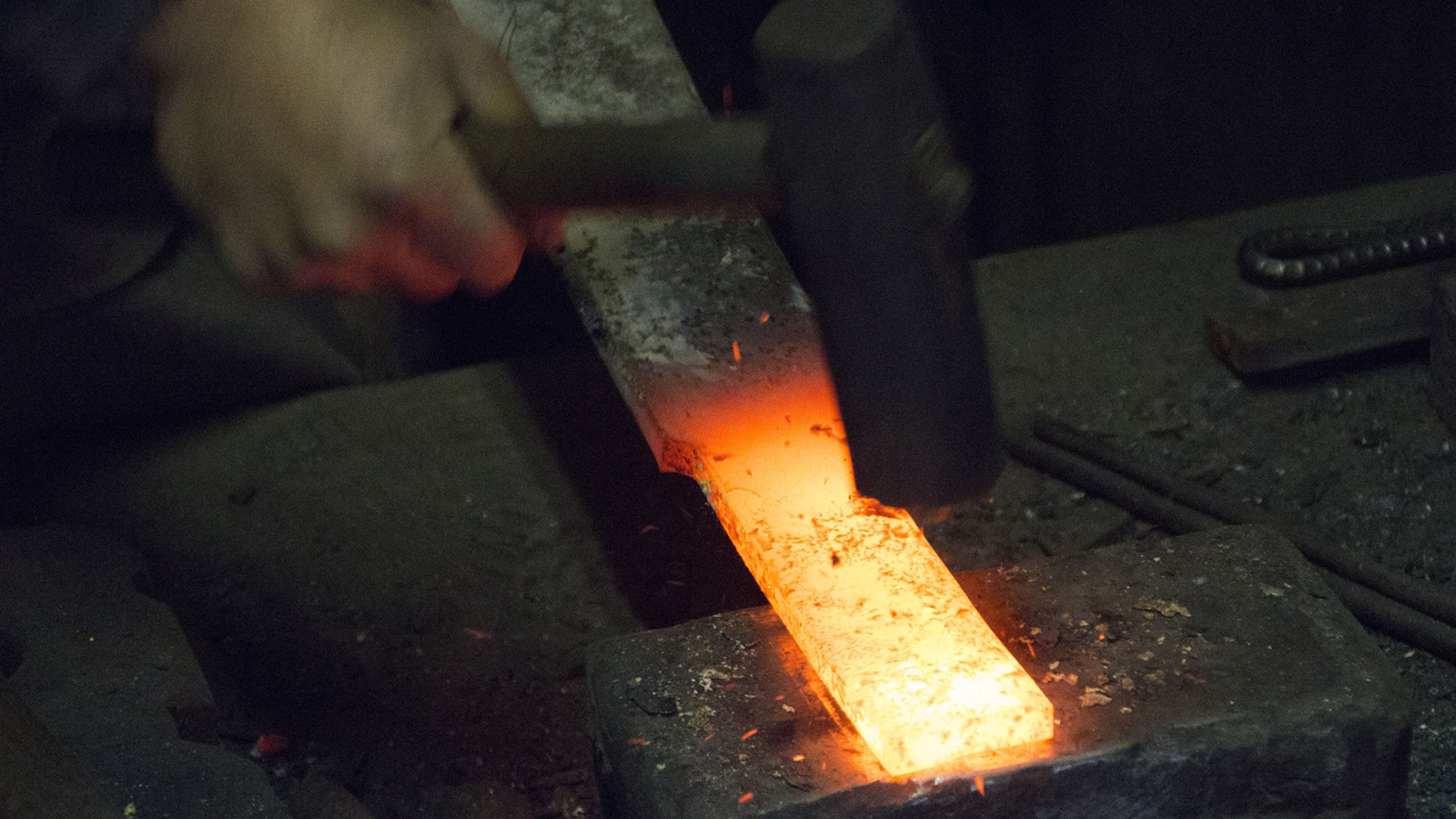
The process begins with the blacksmith. For a traditional forged blade, steel is heated and shaped through repeated hammering. In some constructions, hard steel that will form the cutting edge is joined with softer iron, allowing the two materials to perform different roles in the finished blade.
The blacksmith controls the shape and thickness of the blade while preparing it for heat treatment.
2. Hardening and Tempering
The blade is heated and quenched to harden the steel, then tempered under controlled conditions. These stages affect the balance between hardness and toughness. Sufficient hardness allows the cutting edge to be sharpened finely and retain its geometry, while tempering helps reduce excessive brittleness.
Temperature, timing, steel composition, and the skill of the maker all influence the result.
3. Sharpening and Shaping the Edge
Once the blacksmith's work is complete, the blade passes to a specialist sharpener. Sharpening here means more than making an existing edge sharper. The sharpener establishes the final blade geometry, working on the bevels and surfaces that determine how the knife meets food.
For a traditional single-bevel knife, this includes shaping the main bevel and refining the reverse side, including the shallow concave structure known as urasuki.
4. Handle Fitting and Final Finishing
After sharpening, a handle is fitted to the tang, and the knife is inspected and adjusted before completion. Handle materials, shapes, and finishing methods vary among products.
By the time a traditional Sakai knife reaches the kitchen, several specialists may therefore have contributed to a single tool. The finished knife is not simply the result of one maker's repeated actions, but of expertise divided across different stages of production.
The right Sakai knife depends less on finding a universally “best” blade than on matching its shape, construction, material, and maintenance needs to the way you actually cook.