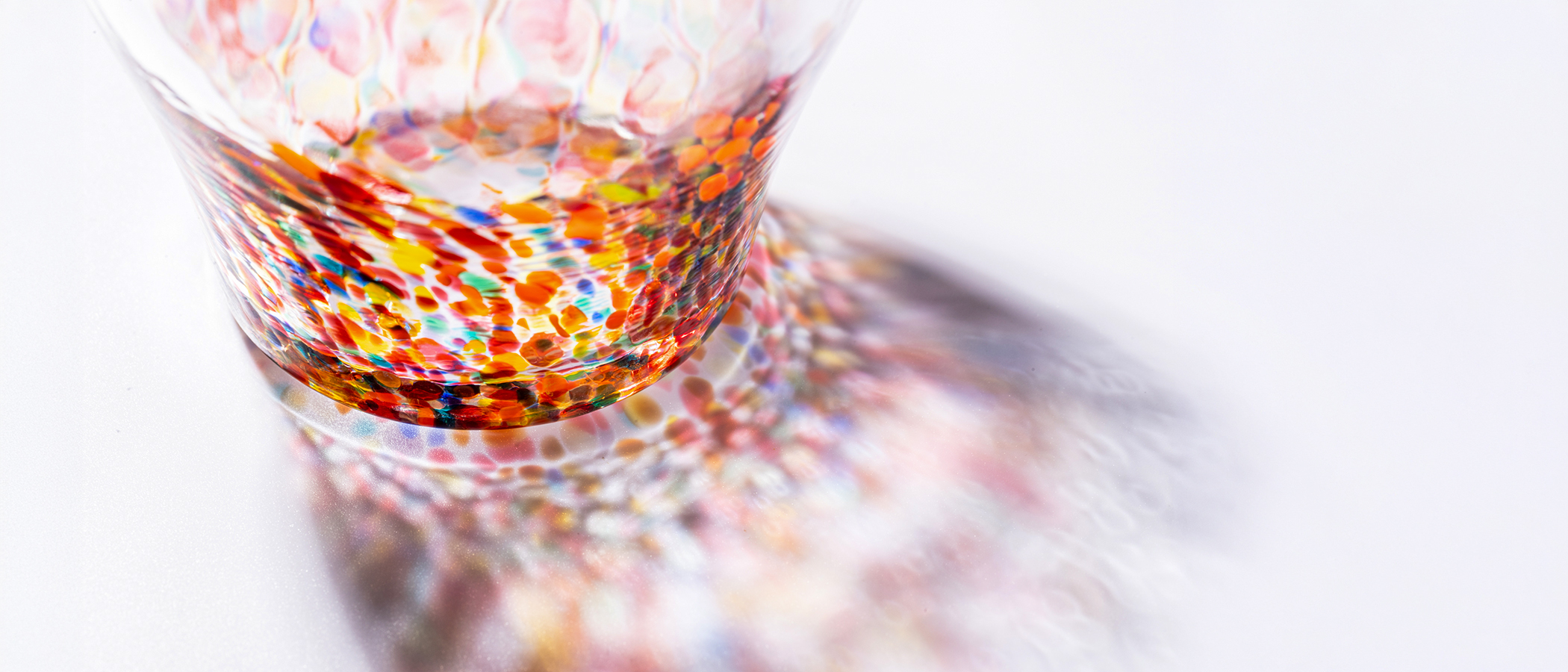

Pour cold tea into a clear glass, and the colored glass at the base looks different than it did a moment ago, empty. Light from a window shifts the layers of color, and the shadow they cast across the table changes with it.
Tsugaru Vidro is a blown-glass craft made in Aomori City, in Aomori Prefecture at the northern end of Japan's main island, by the glassmaker Hokuyo Glass. The name combines Tsugaru, the name of the surrounding region, with vidro, a Japanese word for glass derived from Portuguese and introduced to Japan through early contact with Portuguese traders.
Molten glass is gathered on a blowpipe and shaped with an artisan's breath and hand tools, sometimes freehand and sometimes with a mold. Granules of colored glass are added while the glass is still being formed, then reheated so that the color fuses with the glass rather than being applied afterward as paint or a surface coating.
The shape and color therefore develop as part of the same making process. The result appears in everyday objects ranging from tumblers and sake vessels to small bowls and vases, where light, liquid and the surrounding space can change how the colors are seen.
Tsugaru Vidro began not with tableware, but with glass fishing floats.
Hokuyo Glass was founded in Aomori in 1949 and originally manufactured hollow glass floats used to keep fishing nets afloat at sea. Producing these spherical objects repeatedly and reliably required control over blown-glass forming and quality, and the skills developed through float production later became an important technical foundation for Tsugaru Vidro.
A turning point came in the 1970s. According to the history recorded for the craft, an artisan experimented with using white sand from Shichiri-Nagahama, a long stretch of coastline on the western side of the Tsugaru Peninsula, as a glass material. The experiment unexpectedly produced a deep green glass.
That discovery encouraged further research into colored glass, including colors inspired by the natural landscapes and seasonal scenery of Aomori.
Around the same period, plastic and resin floats increasingly replaced glass floats in the fishing industry, reducing demand for Hokuyo Glass's original product. The company responded by combining the blown-glass skills developed through float production with its research into color.
In 1977, Tsugaru Vidro was launched as a line of glassware for everyday use.
The craft was designated an Aomori Prefecture Traditional Craft in 1996. Hokuyo Glass later became part of the Ishizuka Glass group, and Tsugaru Vidro today extends across tableware, sake vessels, vases and other glass objects.
Its history is therefore not simply a story of preserving an old form unchanged. A technique developed for an industrial fishing product was redirected toward tableware when the original market declined, while experiments with colored glass gave the new products a visual identity connected to Aomori.
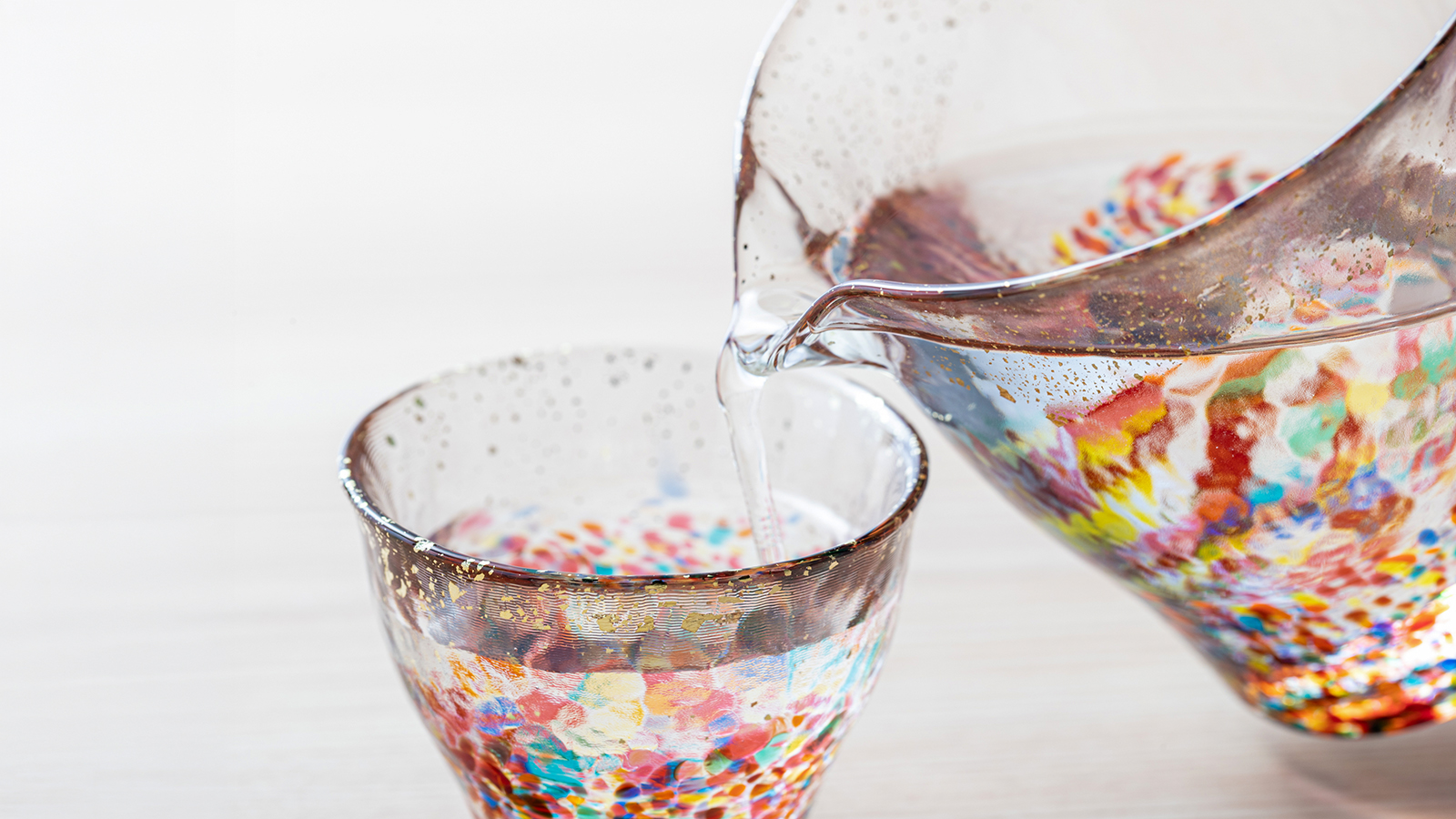
Tsugaru Vidro is recognizable for the subtle variation of blown glass and the way color is incorporated directly into the material.
Depending on the product and forming method, pieces may differ slightly in contour, thickness or color placement, and occasional small bubbles can occur. Finished pieces are inspected, while subtle variations that remain can reflect the process of shaping molten glass by hand.
The color is not simply painted onto the finished object. Small granules of colored glass, or color frit, are applied while the base glass is hot and reheated so that they fuse with it. Their placement and layering give the glass visual depth, changing with the direction of light, the thickness of the glass and what is seen through it.
Hokuyo Glass has developed more than 100 colors through its color research, with selected combinations used for individual designs. Some collections draw on Aomori's seasons, landscapes and local culture, from cherry blossoms and snow to coastal scenery and the Aomori Nebuta Festival, a summer celebration known for its enormous illuminated floats.
1. Gathering the Molten Glass
An artisan gathers molten glass onto the end of a blowpipe, rotating the pipe to keep the hot glass centered and under control. At this stage, the glass is still soft enough to respond to gravity, rotation, tools and the artisan's breath.
2. Adding the Color
Small granules of colored glass, known as color frit, are applied to the hot glass according to the intended design. The glass is then reheated so that the frit softens and fuses with it. Makers may use multiple colors, controlling their placement and combination as the piece develops.
3. Reheating the Glass
Glass cools continuously while it is being worked, so it must be reheated during forming. The artisan returns the piece to a reheating furnace, often called a glory hole in English-language glassmaking, to restore enough heat for further shaping.
The balance is delicate: the glass needs to remain workable without becoming so soft that the intended form is lost.
4. Shaping the Form
In free-blowing, known in Japanese as chūbuki, the artisan shapes the inflated glass without using a mold. Breath, rotation and hand tools are used to control the form as the glass cools and is reheated.
In mold-blowing, or katabuki, the hot glass is inflated inside a mold, which helps establish more consistent external dimensions.
5. Forming the Rim and Final Details
Once the main body has been shaped, the rim and other details are refined according to the object. The artisan continues to rotate and manipulate the glass while it remains workable, adjusting the opening and final proportions.
6. Annealing
A newly formed glass object cannot simply be left to cool at room temperature. Instead, it is placed in an annealing kiln, where its temperature is reduced gradually and under controlled conditions. This relieves internal stresses that could otherwise weaken the glass. After cooling, the piece can be inspected and, where necessary, undergo additional finishing.
7. Inspection and Finishing
Finished pieces are checked for factors such as shape, surface condition and structural quality. A subtle difference in color placement or contour may be part of the character of a blown-glass piece, while structural defects are a separate matter.
Tsugaru Vidro varies in how the glass is formed.
Free-Blowing — Chūbuki
In free-blowing, or chūbuki, molten glass is inflated and shaped without a mold. The artisan controls the form through breath, rotation, gravity and hand tools. Because a mold does not establish the outer dimensions, subtle differences in contour, thickness and proportion can remain from one piece to another.
Mold-Blowing — Katabuki
In mold-blowing, or katabuki, hot glass is inflated inside a mold that establishes its outer form. The mold makes it possible to achieve more consistent dimensions and capacity while the application and movement of colored glass can still create visual variation between pieces.
Tsugaru Vidro tends to change with what surrounds it. That relationship between glass, color, light and whatever the object contains is part of what makes it useful beyond display.