
On a trip to Saga Prefecture in search of Arita ware, I visited Okawachiyama in Imari, the city next to Arita.
Imari is itself a major ceramics center. Ware made in both Arita and Imari used to be shipped out through Imari’s port and grouped together under the single name “Imari ware.” Today, the names Arita ware and Imari ware distinguish the two places of production.
Okawachiyama is a small mountain town, kilns lining a stone-paved slope one after another. One workshop stood out — a large brick chimney rising above it.
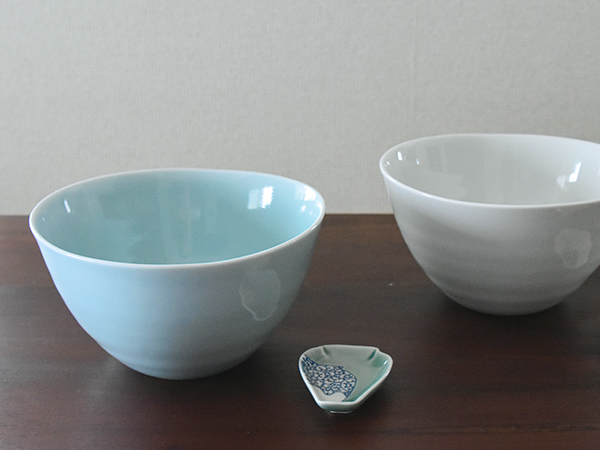
Inside were pieces glazed in a clear blue-green, and others in white patterned with fine indigo or colorful designs. What caught my eye most were the celadon pieces — some closer to a pale, light blue, others a deeper, greener shade. Drawn to that transparent blue that seems to pull you in, I picked out a few pieces and bought them.
That was how I came to have Seizan Kiln’s tableware.
The pieces have been part of my kitchen cupboard ever since. The bowls come out for soup, for rice bowls, for noodles. The small dishes, known as otesho, hold salt, spices, olive oil, or mustard.
The white and celadon pieces are understated, but they sit well with the color of the food, quietly bringing it out. Setting an otesho dish on the table brings a bit of playfulness with it too.
Whenever I prepare a meal, I find myself wondering whether I could use the Seizan Kiln pieces. I’ve noticed how that small moment makes me happy.
Okawachiyama was home to a kiln run directly by the Nabeshima domain in the Edo period, and kilns still line the town today. Seizan Kiln traces its roots to that domain kiln and was founded as a private kiln in 1883.
The Imari-Nabeshima ware fired in Okawachiyama includes several traditional techniques: Iro-Nabeshima, combining blue underglaze with red, yellow, and green overglaze decoration; Nabeshima celadon, known for its blue-green glaze; and Nabeshima sometsuke, with blue designs painted beneath the glaze.
Seizan Kiln carries these long-standing local traditions forward while also developing new techniques and collaborating with designers to create tableware for contemporary life.

The more I use them, the more these pieces become a familiar part of my table. Even now that they’re familiar, the pleasure of choosing which one to use for a meal, or wondering what to put in the otesho dish, hasn’t gone away.
The bowl I use for soup or noodles could hold a salad.
The colors of the food could help me choose between white and celadon.
It seems like it would be fun to serve the same food in a different bowl sometime, just to see how it looks.
For the small otesho dishes, there’s salt, spices, olive oil, or mustard. One could sit beside a larger dish, or alongside another small plate I already have. There’s a pleasure not just in deciding what goes in, but in deciding which pieces to put together.
What will I serve in my favorite piece next?