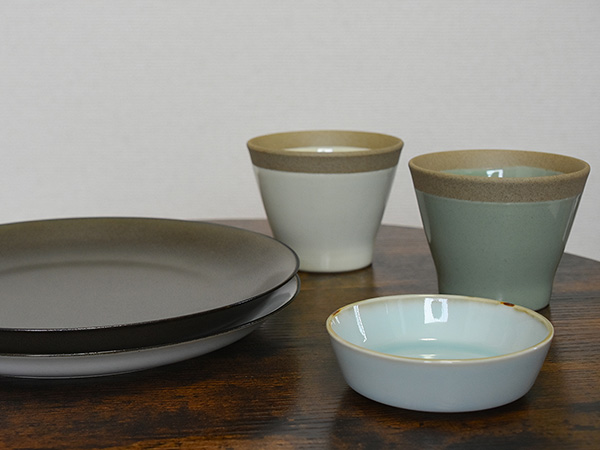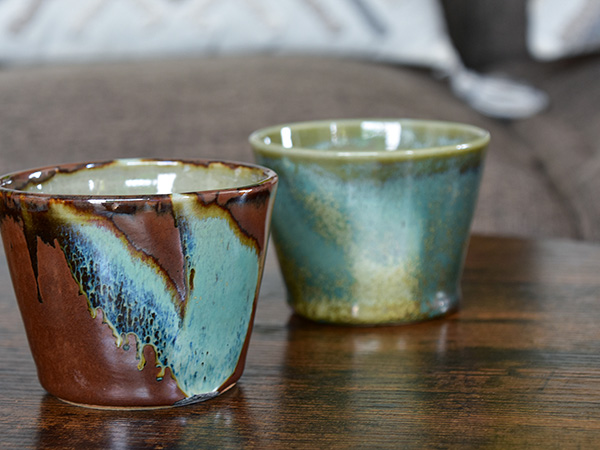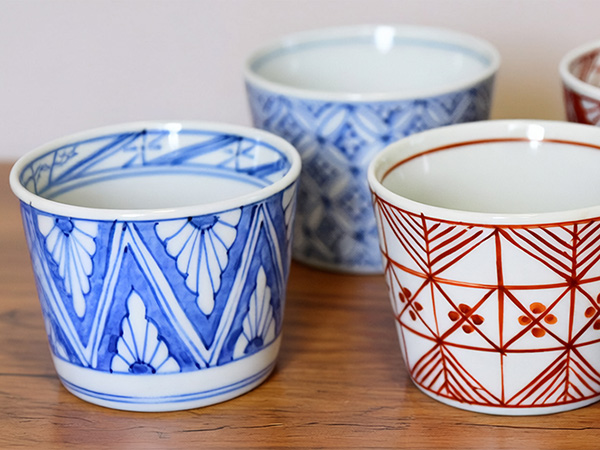
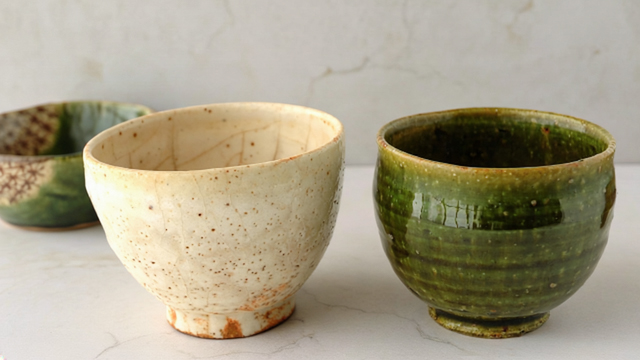
A milky-white surface with a softly uneven texture. A teacup covered in a deep green glaze. Their colors, surfaces, and shapes may be entirely different, yet both can be Mino ware.
Made in the Tōnō region of Gifu Prefecture in central Japan, Mino ware is not defined by a single form, pattern, or palette. The white surfaces of Shino, the greens of Oribe, the yellows of Kiseto, and the deep blacks of Setoguro all developed within the same production region, each with its own materials, glazes, and firing methods.
Mino ware includes earthenware and porcelain, as well as semi-porcelain that sits somewhere between the two. The objects made are equally varied, from plates, bowls, and teacups to mugs — encompassing historic tea vessels as well as tableware made for everyday use today.
Materials, forming methods, glazes, and firing techniques differ according to the type of ware and the tradition of making behind it. In 1978, Mino ware was designated a Traditional Craft under Japan’s national system for recognizing historically established craft traditions. Today, the designation encompasses 15 officially recognized techniques.
So how did one regional tradition come to hold such a wide range of expressions? Looking at that history makes it possible to see more in an everyday plate or cup: not simply its color or shape, but the materials, techniques, and generations of making that have shaped the region.
The roots of ceramic production in the Mino region are thought to extend back to Sue ware, a type of high-fired stoneware introduced to Japan from the Korean Peninsula, made between the fifth and seventh centuries, when kiln technology associated with Sanage, an important historic ceramic production area in present-day Aichi Prefecture, spread into what is now eastern Gifu Prefecture.
A major period of development came in the second half of the sixteenth century. As tea culture expanded, kilns in the region produced distinctive new glazes and forms that are now associated with styles such as Shino, Oribe, Kiseto, and Setoguro.
Ceramic production in Mino was also closely connected with nearby Seto, in present-day Aichi Prefecture. Potters are thought to have moved from Seto into Mino during the late sixteenth century, although accounts differ on why. Some explanations point to regional conflict, while others connect the movement to policies under Nobunaga Oda, one of the most powerful warlords during the mid sixteenth century. The precise circumstances remain uncertain, but the movement of people and techniques between the two areas played an important role in Mino's development.
The ceramics produced there were not yet known as “Mino ware.” The name itself appears in written records from around 1832. Before the Meiji era (1868), ceramics made in Mino were often distributed under the Seto name, and tea wares in the second half of the sixteenth century now identified with Mino were long believed to have been made in Seto.
That understanding changed significantly in 1930, when potter Toyozō Arakawa excavated the Ōgaya Mutabora kiln site in what is now Kani City. His findings demonstrated that important Shino and Setoguro wares from the second half of the sixteenth century had in fact been produced in Mino. The discovery helped reshape the historical understanding of some of Japan's best-known tea ceramics and brought renewed attention to the region.
From the Meiji era (1868-1912) onward, Mino developed a clearer regional identity and expanded beyond historical tea ware into a major center for everyday ceramics and tiles. That expansion continues to shape the region today, where traditional studio practice, specialist craft production, and mechanized manufacturing all form part of the same ceramic landscape.
The defining characteristic of Mino ware is its diversity. Because the name refers to a production region rather than a single style, pieces can differ substantially in material, surface, color, and form.
Pottery and porcelain offer noticeably different material properties. Pottery is generally more absorbent and does not transmit light, while porcelain has very low water absorption and can become translucent when made thin enough. These differences sit alongside further variation in clay bodies, glazes, firing conditions, and forming methods.
The historical styles associated with Mino make this diversity easy to see, which you can find in the “Types & Variation” section in this article. Yet these historical styles are only part of the picture. Mino ware also includes techniques such as sometsuke (blue-and-white underglaze decoration), akae (red-dominant overglaze enamel decoration), celadon, kohiki (a pale slip applied over a darker clay body), and many others recognized within the region's traditional craft designation.
Modern production is equally varied. Some pieces are formed and finished individually by craftspeople, while others are made using molds, casting, roller-forming, or printed decoration for everyday tableware. Rather than separating these into “authentic craft” and “industrial product,” it is more accurate to see both as part of the scale and diversity of the Mino ceramic industry.
The result is a ceramic tradition that cannot be reduced to one visual formula. A Mino ware piece is better understood by looking closely at what it is made from, how it was formed and fired, which glaze or decoration it uses, and what role it is designed to play at the table.
Because Mino ware includes pottery, porcelain, studio work, and industrial production, there is no single manufacturing process shared by every workshop. Even so, many pieces follow a broadly similar sequence from raw material to finished ceramic.
1. Preparing the Clay Body
Production begins with preparing the ceramic body.
Depending on the type of ware being made, workshops select and blend different clay bodies or ceramic materials to achieve the desired firing characteristics, color, texture, and strength. The material is refined, mixed with water, and kneaded to remove air before forming begins.
The choice of material is one reason Mino ware can include both pottery and porcelain within the same regional tradition.
2. Forming
The prepared body is shaped into plates, bowls, cups, or other forms.
Some makers use the potter's wheel for individual pieces, while others employ plaster molds, slip casting, pressure casting, roller forming, or jiggering for larger-scale production. The forming method depends on the intended design rather than indicating differences in authenticity.
3. Drying and Trimming
After forming, each piece is dried gradually until it reaches a stable condition for trimming.
At this stage, excess material is removed, rims are refined, and the foot ring is shaped. Controlled drying helps reduce cracking and distortion before firing.
4. Biscuit Firing
The dried ceramic body is fired for the first time at a relatively low temperature. This biscuit firing strengthens the piece while leaving it porous enough to accept glaze and decoration.
5. Glazing and Decoration
Decoration depends on the style being produced. Some wares receive feldspathic glazes, ash glazes, iron glazes, copper glazes, or clear glazes. Others are decorated with painted motifs before glazing, while overglaze enamels are applied after the main firing.
6. Final Firing and Inspection
The glazed ceramics are fired at temperatures appropriate to their material and glaze. After cooling, each piece is inspected for shape, glaze quality, decoration, and structural integrity. Depending on the workshop, additional finishing may include polishing the foot ring, applying the maker's mark, or final quality checks before shipment.
Rather than following one visual identity, Mino ware encompasses numerous ceramic traditions that developed across the same production region. Among them, four historical styles are particularly influential.
Another notable Mino style is Setoguro, known for its deep black surface. Its distinctive color is created by removing an iron-glazed piece from the kiln at high temperature and cooling it rapidly.
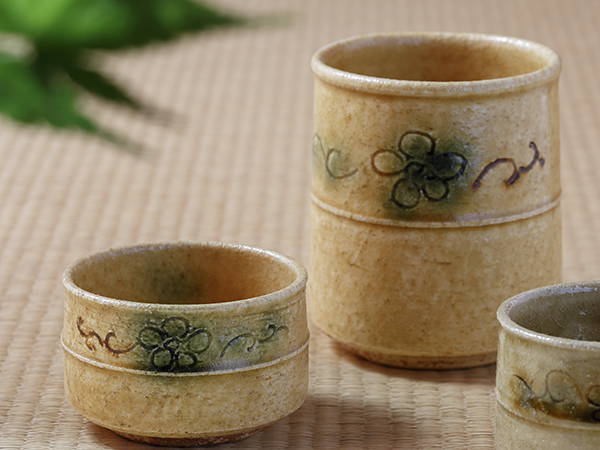
Mino ware fits naturally into everyday life because it offers such a wide range of materials, forms, and surfaces.
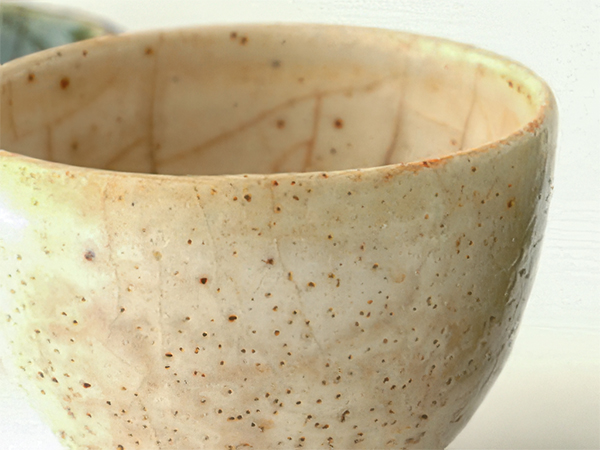
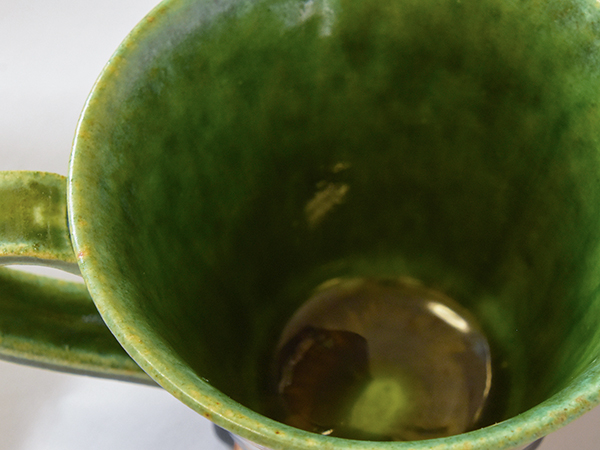
A white Shino mug may soften the appearance of morning coffee through its textured glaze, while an Oribe plate adds a vivid green accent beneath vegetables or seasonal fruit. A simple porcelain bowl and a handmade pottery dish can comfortably share the same table without feeling inconsistent.
This flexibility comes from the tradition itself. Since Mino ware is not limited to one aesthetic, different pieces can be combined according to use rather than matched as a formal set.