
In the morning, I grind coffee beans. Their aroma drifts through the room.
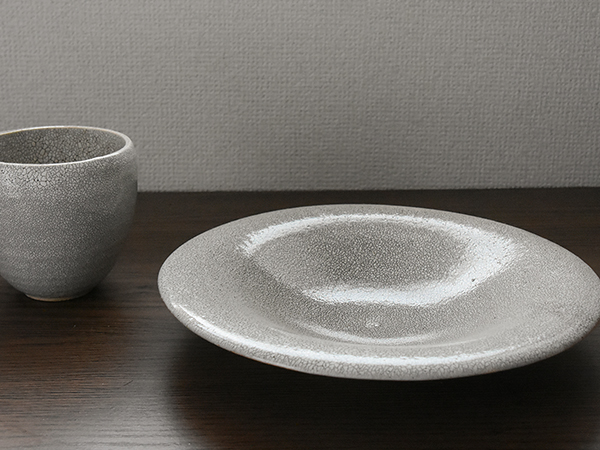
I look over the cups lined up on the shelf and decide which one to use. I reach for a favorite: a Mino ware cup covered in fine lines that run across its surface. I take a moment to look at the pattern before pouring the coffee.
I found the cup at a pottery market while visiting Toki, Gifu Prefecture. The intricate crackled pattern across its surface caught my eye, and I liked it immediately. It was also the first time I encountered the word kairagi.
I look over the surface. Fine and larger lines spread unevenly across the cream-white glaze. The cup is slightly thick-walled; when I cradle it in both hands, I feel the warmth of the clay.
With each sip, I turn the cup slightly. A different expression appears at every angle. From every side, the pattern feels delicate and somehow fleeting. As I follow the lines with my eyes, I find myself growing calmer.
Spending a few moments looking at this irregular pattern has become one of my favorite parts of the morning.
Hyozangama is a Mino ware kiln in Toki, Gifu Prefecture. Sabi-Kairagi is one of the kiln’s signature expressions.
Kairagi refers to the distinctive surface pattern left when the glaze shrinks during firing. Its name comes from the texture’s resemblance to ray or shark skin once used to decorate sword hilts and scabbards.
At Hyozangama, the kairagi treatment is applied to a dried piece before it is bisque-fired. The piece is then dipped in sabi, a rust-colored wash, and rinsed, leaving the color in the fine network of lines.
Look closely at a piece of sabi-kairagi ware, and you can see small brown, rust-colored marks across the surface. The way the glaze and rust-toned pigment adhere to the surface, the path of the flame, and shifts in temperature as the kiln cools all affect the finished pattern, so no two pieces are identical.

The lines on the cup vary in size and density across its surface. Even after using it every day, my eye is still drawn to different parts of the pattern.
I look at it before I pour and again while I drink. By now, it is simply part of my morning.
Since I started using this sabi-kairagi cup, the time I spend over my morning coffee has become calmer still. I have also begun to look forward to choosing which cup or dish to use for a meal.
Before pouring your next drink, look once at the cup you usually reach for. There may be something in its lines, color, or shape that you have not noticed before.
Tomorrow morning, before I pour, I will look at that pattern again.