

There are kokeshi dolls in my living room.
I don't use them for anything. Still, every now and then, without really thinking about it, I find myself looking at them. A row of sweet, smiling faces lines the room, and something in me feels warmer. With the kokeshi there, it's as if a kind of warmth spreads through the room, and looking at them soothes me.
About ten years ago, I started bringing kokeshi home whenever I visited the hot-spring towns of Tohoku, in northeastern Japan, including Togatta Onsen and Naruko Onsen. I bought them at local kokeshi shops, makers' workshops, and souvenir stores, and have added them to my living room a few at a time.
The first kokeshi I remember noticing was at my grandmother's house when I was a child. My grandparents' shelves were filled with dolls and ornaments bought on trips around Japan and abroad, and I was endlessly curious about where each one had come from. A kokeshi was among them.
The first one I bought myself came much later, when I was working and visited Miyagi Prefecture to cover a story for a magazine. In a souvenir shop, I found a tiny kokeshi, small enough to sit in my palm, packed in a can. It was so endearing that I bought one on the spot. That was when I became properly aware of kokeshi.
There were regional styles, each with its own traits. Some had narrow eyes, others big, round ones. The size of the nose, the lift at the corners of the mouth, the shape of the body, the hairstyle, the patterns. Every one had its own features, and every face was endearing. I was captivated almost at once, and from then on I bought kokeshi whenever I traveled in Tohoku.
A Kokeshi Shop in Togatta
What made me want to know more was a visit to a kokeshi shop in Togatta Onsen, Miyagi Prefecture.
The shop was lined with kokeshi from many different regions and styles, from large ones down to ones no bigger than a finger, packed into every available space. What set it apart was that every single doll was old and pre-owned.
The man at the shop told me a great deal. The makers of kokeshi are known in Japanese as kōjin. Each region has its well-known makers, and every year they compete in a kokeshi competition. Kokeshi by well-known makers are popular with collectors, and many collectors seek out the work of makers who have passed away. The maker's name, written with a brush on the underside of the body, is a clue to whose work a doll is.
Collectors, he said, buy the work of makers they love and keep it carefully at home, sometimes on display, sometimes boxed and tucked at the back of a cupboard. Those dolls come onto the market when an owner dies or lets them go for some reason, and shops like this one are where they end up. That is why each encounter with an old kokeshi is a one-time chance.
Each time I picked up a doll that caught my eye, he explained it in detail: the maker who made it, the features of its patterns and face, the maker's lineage and the work of their successors. Listening to him, I became completely captivated. I left the shop with three or so, including a Togatta kokeshi.

Traditional kokeshi are wooden dolls from Tohoku, with shapes and painted patterns that vary by region and lineage of makers. In the case of Miyagi traditional kokeshi, the wood is turned on a lathe to form the doll, and then the face and the patterns on the body are painted. Their makers are known in Japanese as kōjin. Even within the same regional style, patterns vary from one maker to another.
Even kokeshi sold new can carry the maker's name. Kokeshi Can, sold by Kokeshi no Shimanuki in Sendai, is described by the company as kokeshi made specifically for the product by traditional kokeshi makers from various regions and then packed in a can.
The National Kokeshi Doll Competition, which judges the work of kokeshi makers, is still held every year. Its officially published list of award winners records the category, the title of each piece, the prefecture or regional style, and the maker's name.
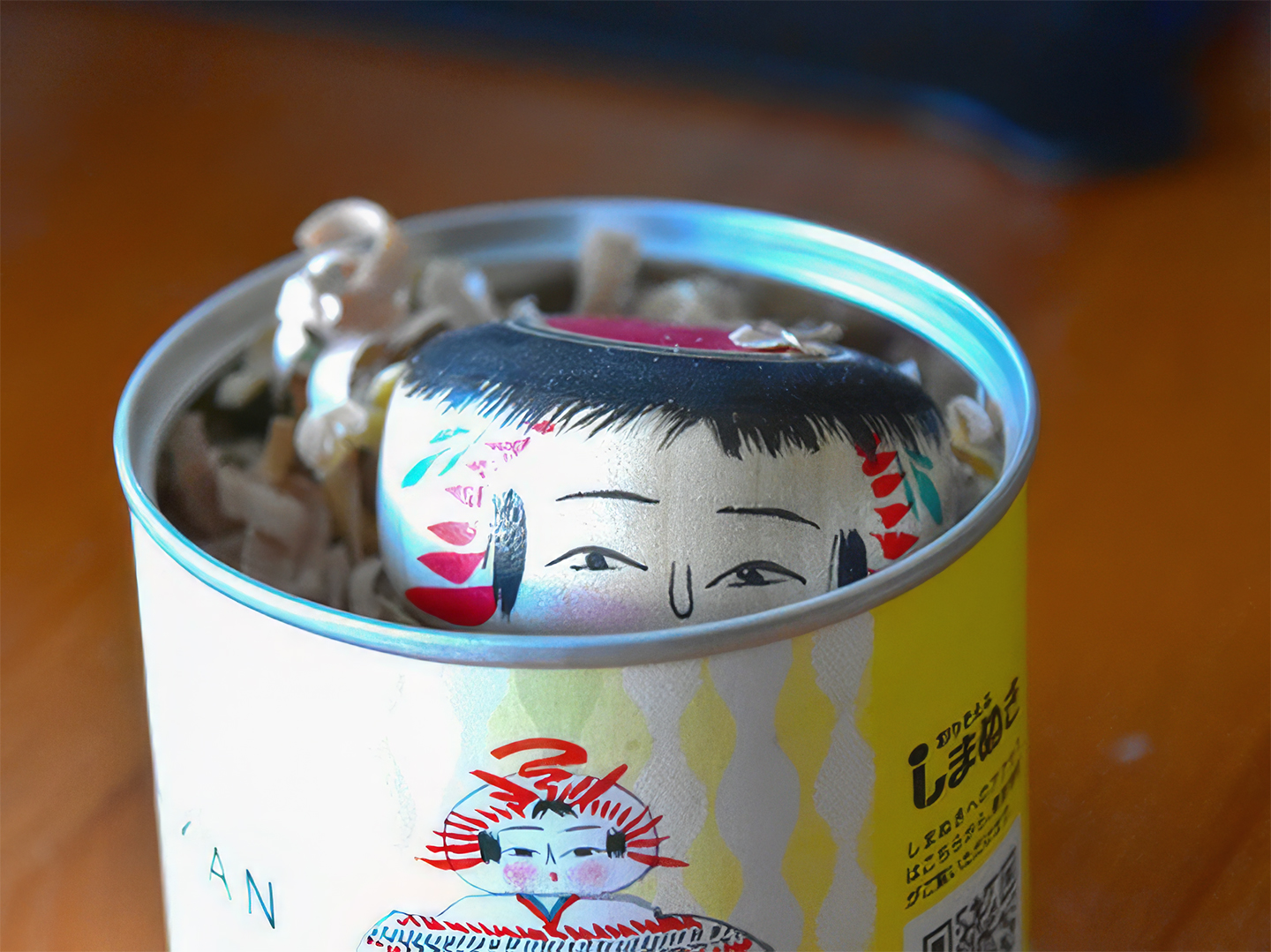
When I pick them up one by one, I can see that no two faces are alike. One has narrow eyes, another small eyes, another big, round ones. Some have long, narrow noses, others round button noses. Some are grinning, some wear a slightly wry smile, some are expressionless, and some look a little anxious. No two are the same, and I never tire of looking at them.
When I choose one, its expression matters most. From among them, I bring home the one that feels somehow on my wavelength, the one that just clicks.
Picking one up, I feel the warmth of the wood. Along with the warmth of its expression, the feel of the natural wood and the warmth I feel in my fingers deepen my attachment. Because I take my time choosing, I can't help feeling deeply attached from the moment I buy it.
Behind each face are a maker's name, a regional style, and the time that has passed since it was made. The stories I heard at that shop are part of that background for the kokeshi lined up in my living room.
I never use them for anything. I simply keep them on display. And yet, whenever I glance over, there they are in the living room, a row of sweet faces.