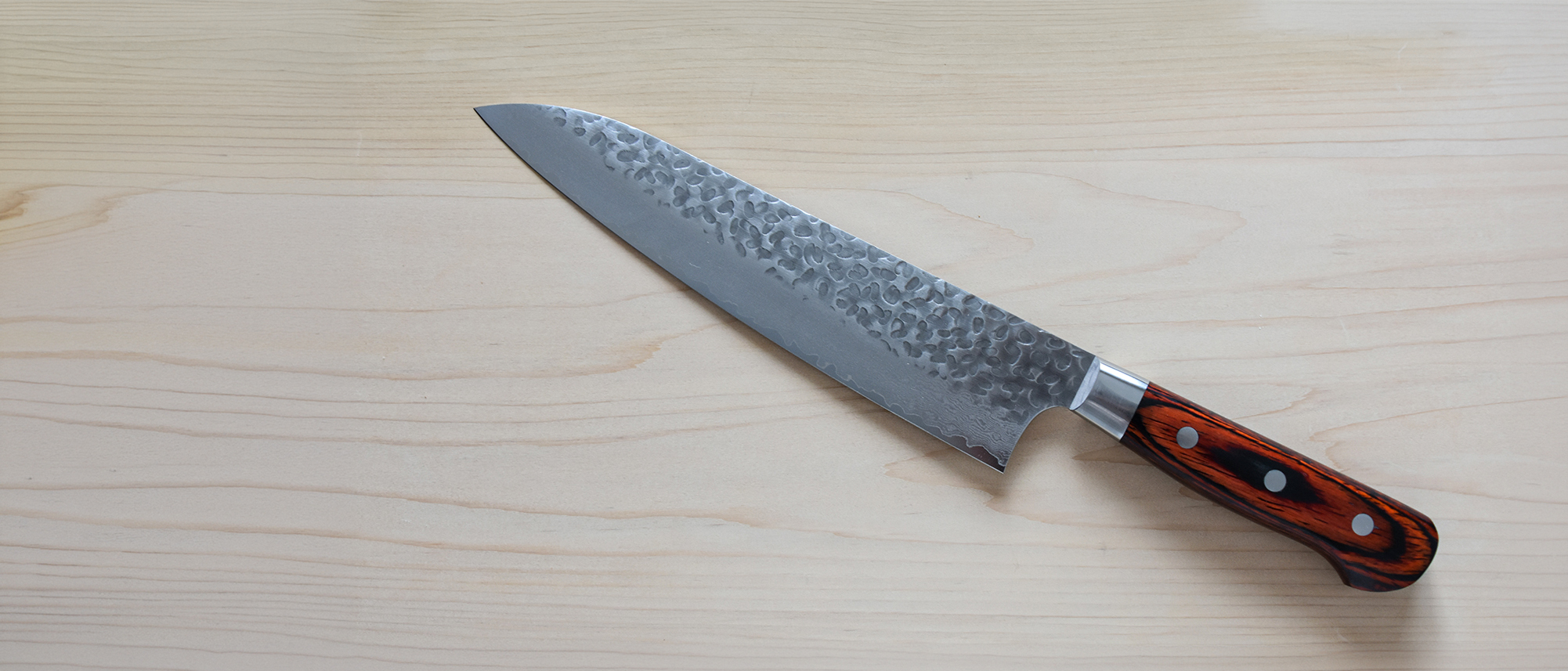

Until then, I had been using an inexpensive short-bladed santoku, an all-purpose Japanese kitchen knife that I felt no particular attachment to. Wanting a well-made knife I could use for years, I chose a Sakai Takayuki gyuto—a Japanese-style chef’s knife—with a VG10 core and 33-layer Damascus cladding.
In this knife, the layered steel around the core creates the wave-like Damascus pattern visible across the blade. Together with the hammered finish, that pattern was what first drew me to it.
The first thing I cut was a whole cabbage. I cut it in half, then shredded it.
With my old knife, cutting through the cabbage produced a heavy chopping sound. With the gyuto, the cuts were almost quiet, broken only by a few light taps. I barely had to push; the blade seemed to slip into the cabbage on its own.
That was the first time I realized that sharpness was not simply a matter of whether a knife could cut through something. I could hear it in each stroke and feel it in how little pressure my hand had to apply.
The difference was clear from the first cut. I did not need to lean my weight into the knife or press hard. Moving my hand up and down was enough for the blade to pass through the food with almost no resistance.
Since around the fifteenth century, Sakai in Osaka Prefecture has developed as a center of Sakai Uchihamono, or Sakai forged blades. The work has traditionally been divided among specialists responsible for forging, sharpening, and fitting handles. Sakai blades are valued by cooks in Japan and abroad for their durability and sharpness. In 1982, Sakai Uchihamono was designated a Traditional Craft by Japan’s Minister of Economy, Trade and Industry.
Aoki Hamono Seisakusho, founded in 1947, develops knife brands including Sakai Takayuki. Its range includes Japanese-, Western-, and Chinese-style kitchen knives, as well as pastry knives, sold in Japan and overseas.

Since I started using the Sakai Takayuki gyuto, I have found myself paying attention to how the blade enters meat and vegetables.
The change was not limited to sound and effort. When I compared pieces cut from the same cabbage with my previous knife and the Sakai Takayuki gyuto, I perceived more sweetness and umami in the pieces cut with the gyuto. The same cabbage tasted different to me depending on which knife I had used. That was a new discovery.
When the edge begins to feel less sharp, I give it a light sharpening on a whetstone. After use, I wash it straight away, wipe it dry, and return it to its place. The care has been less burdensome than I expected before I began using it.
I continue to use it this way, noticing the sound of the blade as it enters each new ingredient and how much pressure I need to apply.
I sharpen it, wash it, wipe it dry, and use it again for the next meal.
Even now, the soft sound of the blade moving through an ingredient takes me back to that first cabbage.